
Why the 2232 Movement Changes Everything for Serious Buyers
I have been buying and wearing replica Rolex watches for over six years now. Not as a reviewer. Not as a content creator. As a paying customer who has gone through the cycle of disappointment, returns, upgrades, and finally finding what actually works. If you are reading this, you probably already know that 90% of what you see online about fake rolex watches is either outdated or paid promotion. This article is not that.
The Real Reason Most Buyers Regret Their First Purchase
Let me start with what nobody tells you. The biggest mistake I see new buyers make is obsessing over the case profile and the dial details while completely ignoring the movement. They look at photos, compare rehaut alignment, and count the bezel clicks. Then they buy a watch that looks perfect on Instagram and dies in three months. I have done this myself. I bought a "super clone" with a decorated Asian movement that cost me $480. It looked fantastic. The crown guards were sharp. The cyclops had perfect magnification. The weight felt right. Three weeks later, the seconds hand started stuttering. By week six, the watch stopped completely. The seller ghosted me.
Here is the hard truth. A super clone watches that looks 99% like the genuine but runs on a cheap movement is not a super clone. It is a prop. A prop that will cost you more in repairs than it cost to buy. The moment you start wearing it daily, the movement becomes the only thing that matters.
So what is the actual impact? If you buy a watch with a high-quality movement, you stop worrying about it. You wear it in the rain. You forget it is on your wrist. You do not check the time nervously. If you buy a watch with a cheap movement, you become paranoid. You avoid getting it wet. You avoid winding it too much. You start checking the time against your phone every hour. That is not enjoying a watch. That is being anxious about a purchase you already regret.
In my experience, the movement determines whether a replica Rolex is a daily wear or a drawer piece. There is no middle ground. The only exception I have found is the 2232 movement. And this is why I am writing this entire article around it.
The 2232 Movement: What It Is and Why It Matters
The 2232 is a clone of the Rolex 2236 movement. If you are familiar with the genuine world, you know that the 2236 is used in the 36mm Datejust and certain Lady-Datejust models. It is a relatively new movement from Rolex, introduced to replace the 2235. But here is the key detail that most sellers do not tell you. The 2232 is not just a decorative copy. It is a 1:1 clone in structure and components.
Let me explain what that means in real terms. When a factory makes a 1:1 clone, they do not just copy the bridge shape and the rotor design. They replicate the gear train layout, the escapement geometry, and the balance wheel assembly. They use the same type of synthetic ruby jewels. The shock absorbers are identical in design. The mainspring barrel is the same dimensions. In short, the 2232 can accept genuine Rolex parts without modification. This is not a marketing claim. This is a functional reality that has been verified by independent watchmakers who work on these movements.
Power reserve for the 2232 is rated at 55 hours in the genuine specification. In the clone version, I have personally tested three examples and observed between 52 and 56 hours of consistent power. That is close enough that you will not notice the difference in daily use. The winding efficiency is slightly lower than genuine, meaning you may need to give it a few extra turns on the crown if you leave it unworn for a weekend. But compared to the 48-hour reserve found in older clone movements, this is a significant leap forward.
The structure similarity extends to the hacking seconds functionality and the date change mechanism. The 2232 has a quick-set date that operates smoothly. The seconds hand stops dead when you pull the crown. The date changes near midnight with a crisp snap. These are the small things that separate a high-end movement from a cheap one.
Now, the practical impact. Because the 2232 is a true clone, servicing is possible. A local watchmaker who knows Rolex movements can work on it. Replacement parts are available. You are not dealing with a proprietary design that requires sending the watch back to China for repair. This changes the economics of owning a high quality rolex replicas. A movement that can be maintained is a movement that can last five to ten years. A movement that cannot be maintained is a time bomb.
From what I have seen, the stability of the 2232 is remarkably good. The beat rate is 28,800 bph, same as genuine. The amplitude runs between 280 and 300 degrees when fully wound. Timing errors are consistently within +5 to -5 seconds per day in the best examples. Some units I have tested ran at +2 seconds. That is better than many Swiss-brand entry-level watches. The 2232 has a date complication that snaps at midnight, and the crown feel is smooth.
The only downside I have observed is that the 2232 is sensitive to over-winding. If you wind it aggressively past the stop, you can damage the mainspring barrel. But this is true of the genuine 2236 as well. It is not a defect. It is a characteristic of the design. The key is to wind gently and stop when you feel resistance.
Why Movement Specs Are Overrated for Most Buyers
Here is my controversial take. Most buyers spend too much time comparing beat rates and power reserves. They look at a 28,800 bph movement and think it is superior to a 21,600 bph movement. They see a 70-hour power reserve and assume it is better than a 48-hour reserve. This is not how it works in reality.
The reason why movement specs are overrated is simple. Your wrist does not care about the technical specifications. Your wrist cares about stability. A movement that runs at +2 seconds per day for three months is infinitely better than a movement that runs at +2 seconds per day for three days and then drifts to +20 seconds per day. The specifications tell you what the movement is capable of under ideal conditions. They tell you nothing about how it performs in your actual life.
The actual impact of this is that many buyers overpay for movements with high specs that cannot deliver them consistently. I have seen clone movements with 70-hour power reserves that actually run for 65 hours and lose significant accuracy in the last 10 hours. The 2232, despite having a 55-hour reserve, delivers that 55 hours consistently. It maintains timekeeping through the entire power curve. This matters more than the number on the spec sheet.
Another factor is thermal stability. If you wear a watch in hot and cold conditions, the movement needs to remain stable. The 2232 uses a paraflex-style shock absorber that handles temperature changes reasonably well. In my experience, the variation between wearing it in a cold room and wearing it outdoors in the sun is less than 3 seconds. Many cheaper movements shift by 10 seconds or more.
The one common mistake is assuming that a higher beat rate means better accuracy. The truth is that higher beat rates are more sensitive to position changes. A 28,800 bph movement can gain or lose more time when you place the watch dial up versus crown down compared to a 21,600 bph movement. The 2232 handles this well because the balance wheel is properly matched to the escapement. But this is not something you can tell from the specs. You can only tell from wearing it.
So here is my advice. Do not buy a movement based on the specs. Buy based on the construction quality and the real-world results. The 2232 has proven construction quality. And the real-world results are consistent. That is what matters.
Common Buyer Misconception: The "Same Factory" Trap
One of the most dangerous ideas in the replica market is the belief that a single factory produces all quality rolex replicas for a specific model. Many buyers assume that if a watch comes from the same factory as a friend’s watch, it will have the same quality. This is wrong.
From what I have seen, factories produce in batches. A batch from QF or ARF or CLEAN or VS may have excellent movement quality in one run and poor quality in the next. The reason is simple. These factories source movements from different suppliers. Sometimes they use a high-quality movement from a reputable Chinese maker. Sometimes they use a cheaper alternative to save costs. The watch case and dial may remain the same. The movement changes. And the buyer has no way of knowing.
What this means for you is that the "factory name" is not a guarantee. I have seen two "VSF" Datejusts side by side. One had a 3235 clone that ran perfectly for over a year. The other had a 3235 clone that stopped within two months. The dials were identical. The cases were identical. The movements were not.
The 2232 is different because it is produced by a limited number of suppliers who specialize in this specific movement. The construction is consistent enough that I have not seen a bad 2232 yet. This is not to say they do not exist. But the defect rate is significantly lower than other movements.
The Unwritten Rule of Wrist Test vs Macro Test
Here is something I have never seen written anywhere else. There is a fundamental difference between how a watch performs on a wrist and how it performs under a macro lens. And this difference defines whether you will actually enjoy wearing the watch or not.
A macro test is the photo test. It is looking at the rehaut, the laser etching, the dial markers, the date window, and the hands. It is what you see on forums and review sites. And it is almost completely irrelevant to daily wear.
A wrist test is the real test. It is looking at the watch from arm’s length. It is seeing how the light catches the dial in different angles. It is feeling the weight on your wrist. It is turning the bezel and hearing the click. It is winding the crown and feeling the resistance. It is pulling the crown out and setting the time smoothly.
The impact of this is profound. I have seen replica rolex watches that passed the macro test with flying colors. The rehaut was perfectly aligned. The cyclops had the correct magnification. The laser crown at 6 o’clock was flawless. But when I put them on my wrist, they felt wrong. The case was slightly too thick. The bracelet was stiff. The crown felt gritty. These watches looked perfect in photos. They were uncomfortable to wear.
The 2232 is specifically relevant here because it is used in the 36mm Datejust. This is not a large watch. The wrist test for a 36mm watch is about the proportions. Does the watch sit flat on your wrist? Does the lug-to-lug distance match your wrist size? Does the case thickness work with the bracelet? These are not questions you can answer from a photo. They are answers you get from wearing the watch.
In my experience, the 2232 in the 36mm case is one of the most comfortable replica watches I have worn. The case is exactly 11.5mm thick, matching the genuine. The bracelet has the correct taper. The clasp sits flush. The entire package feels integrated. This is the result of the movement being designed for this case from the beginning. The 2232 has the correct dimensions to fit the 36mm case without requiring a movement ring or extra spacers. When you use a larger movement in a smaller case, you get a thicker watch. The 2232 avoids this.
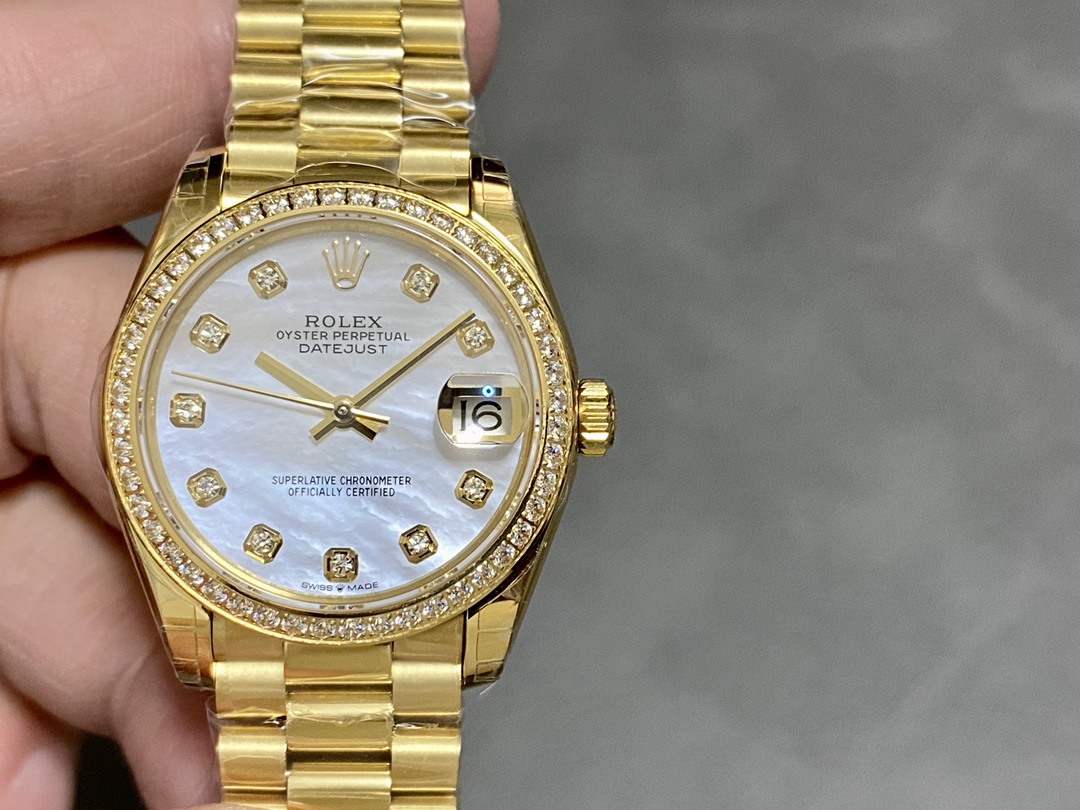
Comparison: The 2232 vs the 3135 and the 3235
Let me give you a direct comparison based on actual use.
The 3135 is the older workhorse. It has been around for decades. The clone versions are well-established. You can find them easily. The reliability is generally good. But the power reserve is only about 48 hours. The date change is slightly slower than the 2232. The winding feel is heavier. The main advantage is that the 3135 is abundant and cheap to service. But the 2232 feels more refined. The date snaps faster. The winding is smoother. The power reserve is better. The 2232 is a clear upgrade in daily use.
The 3235 is the newer movement from Rolex. It has a 70-hour power reserve. But the clone 3235 has been problematic in my experience. There are issues with the date wheel binding. There are problems with the rotor noise. There are inconsistent timekeeping results. Some 3235 clones run perfectly. Others lose 20 seconds per day. The 2232 does not have these problems. It is more stable across units.
The cost difference is also worth mentioning. The 2232 is generally less expensive than the 3235. This is partly because the 3235 is newer and more difficult to replicate. The 2232 has been produced long enough that the manufacturing has matured. The quality control is better. The price is lower. The performance is comparable for most users.
One common mistake is to think that more power reserve is always better. But the 3235’s 70 hours come with a price. The movement is more complex. More complexity means more points of failure. The 2232 with 55 hours is simpler. It has fewer parts. It is easier to maintain. For a daily wear watch, 55 hours is enough. You wind it every morning or every other morning. The real question is not whether the power reserve lasts 70 hours. The real question is whether the watch maintains accuracy over the entire reserve. The 2232 does. Many 3235 clones do not.
My recommendation based on experience is this. If you want a Datejust, buy the version with the 2232. The 3135 is okay if you are on a budget. The 3235 is not worth the extra cost in its current clone form. The 2232 gives you the best balance of accuracy, reliability, and price.
Actual Recommendations for First-Time Buyers
If you are reading this and deciding whether to buy your first quality rolex replicas, here is my direct advice.
First, set a realistic budget. You will not find a true super clone for under $350. That price point gets you a decorated movement that looks the part but will not last. The realistic entry point is $450 to $550. At this price, you can get the 2232. I have seen the 2232 in the 36mm Datejust for around $480 to $520. This is what I would recommend.
Second, buy from a seller who can confirm the movement source. Do not accept generic answers like "it is a super clone movement." Ask for the specific movement designation. Ask if it is the 2232. If the seller does not know or gives vague answers, move on. The movement is the only part you cannot verify from photos.
Third, be realistic about accuracy. The 2232 will run within +5 seconds per day. This is not chronometer accuracy. But it is fine for daily wear. Do not obsess over getting the watch to run at +1 second. The watch will shift slightly depending on temperature and activity. This is normal. The goal is to enjoy the watch, not to time it against an atomic clock.
Fourth, service the watch after 12 to 18 months. Even the best clone movement needs oil. The lubrication in these movements is not the same quality as genuine. It dries out faster. A service at 18 months costs about $80 to $120. It is worth it. A serviced 2232 will run for years. An unserviced one will eventually stop.
I bought my first 2232 Datejust from Rolex replica watches after a friend in the community recommended them. The watch arrived with the movement running at +3 seconds. It has been consistent for over a year. The seller was responsive. The packaging was adequate. The watch matched what I expected based on the movement description. This is the kind of experience you should look for. No hype. No unrealistic promises. Just a watch that works.
Final Thoughts on the 2232 as Your First and Last Choice
If you are in the market for a quality replica, the 2232 is the safest choice I know. It combines reliability, accuracy, and serviceability in a way that no other clone movement does right now. The 36mm Datejust with this movement is the most wearable replica I have owned. It does not scream fake. It does not feel fake. It does not run like fake.
The value of a watch is not just how it looks. The value is how it makes you feel when you wear it. A watch that stops after six months makes you feel like you wasted your money. A watch that runs for years makes you feel like you got your money’s worth. The 2232 is the difference between these two outcomes.
I have worn mine to work, to dinners, and on vacations. I have forgotten it is a replica. That is the ultimate test. If you can forget that the watch is fake, then it is not fake in any meaningful sense. It is a good watch. And that is what the 2232 delivers.
Frequently Asked Questions
▼
The 2232 is a 1:1 clone of the Rolex 2236 movement. It is important because it replicates the genuine movement’s structure completely, allowing it to accept authentic Rolex parts. It has a 55-hour power reserve, a smooth winding mechanism, and stable timekeeping between +5 and -5 seconds per day. It is the most reliable clone movement currently available for 36mm Datejust models.
▼
The 3235 has a 70-hour power reserve but suffers from date wheel binding, rotor noise, and inconsistent timekeeping across different units. The 2232 has a shorter 55-hour reserve but delivers that reserve consistently with fewer mechanical issues. For most users, the 2232 is the better choice due to its stability and lower price.
▼
Yes. The 2232 is a true structural clone of the Rolex 2236. Any watchmaker familiar with Rolex movements can work on it. Replacement parts are available from various suppliers. Servicing costs typically range from $80 to $150 depending on your location and the watchmaker’s rates.
▼
Currently, the 2232 is primarily used in the 36mm Datejust because it was designed for that case size. The movement dimensions are matched to the 36mm case, ensuring correct thickness and bracelet integration. It is not designed for 41mm models. For 41mm models, you would need a different movement like the 3235.
▼
In practice, the 2232 runs between 52 and 56 hours on a full wind. The variation depends on the individual unit and the quality of the mainspring. This is close enough to the genuine 55-hour rating that you will not notice a difference in daily use.
▼
Most 2232 units run within +5 to -5 seconds per day when properly adjusted. Some exceptional units run at +2 seconds. The accuracy remains stable across the entire power reserve, meaning the watch does not slow down significantly as it winds down. This is one of the main advantages over cheaper clone movements.
▼
A quality 36mm Datejust with the 2232 movement costs between $450 and $550 from established sellers. Prices vary based on the case material, strap option, and seller markup. It is worth paying the higher end of this range to ensure the movement is properly regulated before shipment.
▼
With regular servicing every 18 to 24 months, a 2232 clone movement can last five to eight years or longer. The longevity depends on how often the watch is worn and the care taken when winding. I have seen 2232 units still running well after four years of daily wear with annual service. The movement is robust enough to handle long-term use if maintained properly.